
Transformation Is an Ancient Art
OCTOBER 19, 2026
For most of history, cultures carried people through change in three parts, and modern life kept the milestones while removing the crossings. Without that structure, commitment is what holds you in the middle long enough to come out the other side.
Name the crossing you're in right now, and decide before the middle gets hard that you're not turning around.
The promise of transformation is everywhere these days.
This course is transformational. This book is transformational. This beverage is transformational!
And I get it. We all want transformation. But somewhere under all the packaging, we forgot what it actually takes.
The word has been telling us the whole time. Trans means across. Transformation is a crossing: from who you've been to who you're becoming. As a company, as a team, and as a human… you.
The thing is, every crossing, has a stretch in the middle where you're neither. That's the part nobody's selling.
For most of human history, cultures didn't leave crossings to chance. In 1909, the anthropologist Arnold van Gennep noticed the same pattern showing up in rites of passage all over the world. It came in three parts.
First, you left. You were separated from your normal world, your role, and the people who knew exactly who you were.
Then you stayed in the in-between. The old rules didn't apply and the new ones hadn't arrived yet. It was uncomfortable on purpose.
Then you came back, and the community treated you as someone new. That last part matters more than it sounds. It wasn't enough to change. The people around you had to recognize the change, or it didn't hold.
That was the bridge. It carried people from who they'd been to who they were becoming, and nobody was expected to build it alone between meetings.
Then we removed it.
Now there are milestones instead of crossings. You get the promotion, and someone brings a sheet cake to the break room. Graduation, and then Monday. A wedding, and then a registry. A new baby, and then twelve weeks if you're lucky. You sell the company, and there's a wire transfer. The cakes stayed. The crossings didn't.
So if you feel stuck between who you've been and who you're becoming, hear this clearly.
You're not failing at change.
You're standing at the edge of a crossing with no bridge, and everyone around you is telling you to just jump. Or buy the drink.
The anthropologist Victor Turner had a phrase for that in-between stretch: "betwixt and between." It's the part where nothing fits. The old way of operating doesn't work anymore, and the new one isn't there yet. From the inside, it feels a lot like being stuck. It's actually the middle.
The middle is where most people turn around.
Nothing is holding them there anymore. The bridge used to do that. The ritual, the elders, the whole village expecting you to come back different. Now it's just you, a Tuesday, and every good reason to go back to what you know.
And the old way of operating is very good at reasons. It's been winning that argument for years.
This is the heart of my work. No Matter What is the decision that holds you in the middle when every part of you wants to turn around. You may not have a village carrying you across anymore. You can still decide, before you step in, that you're not going back.
Something happens when you stay. What was underneath the old way of operating starts to come through. The people around you start to see someone they didn't expect. And you start to trust yourself in a way you couldn't have planned your way into.
You can't buy that in a can.
The bridge was removed. The crossing wasn't…
Key idea:
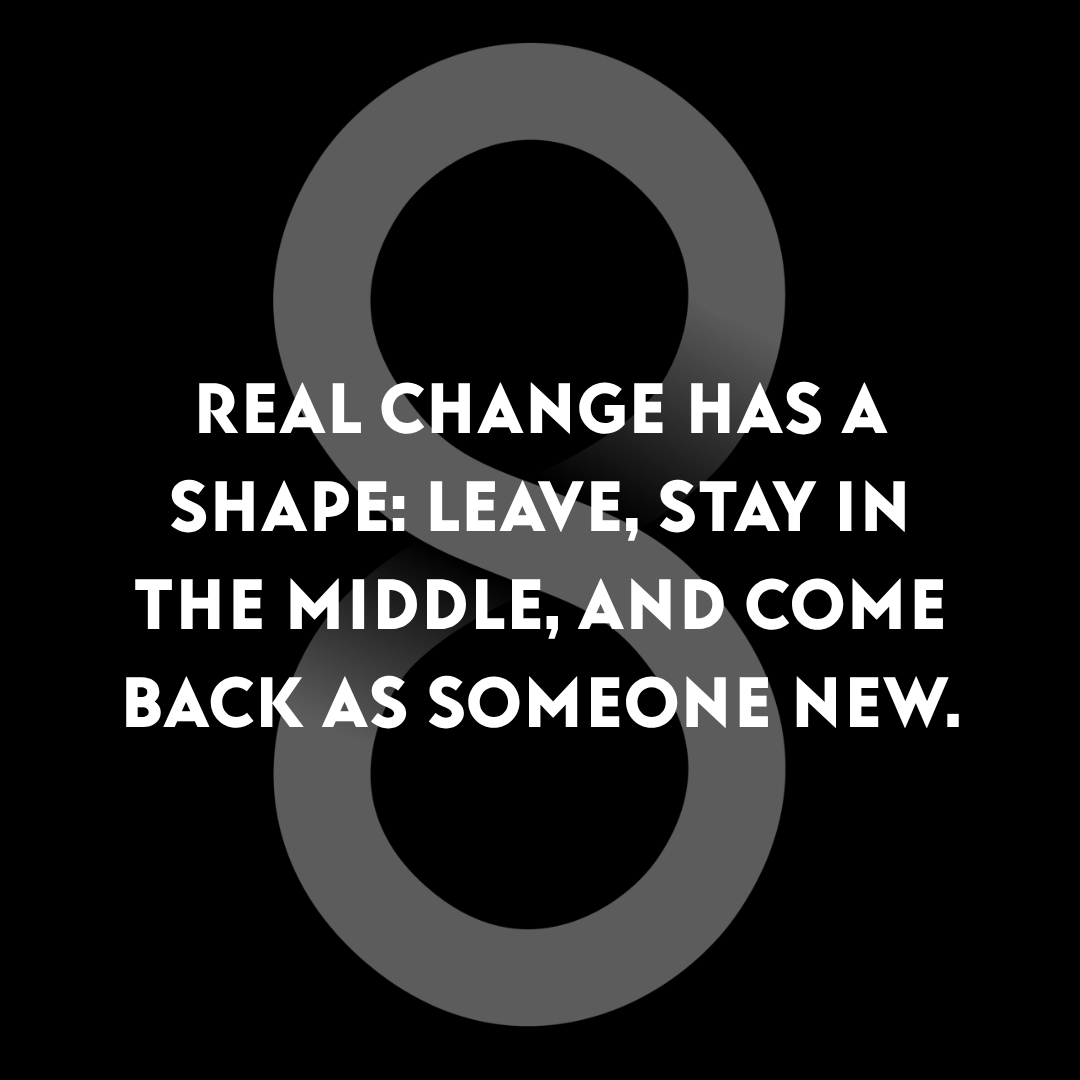
Real change has a shape: leave, stay in the middle, and come back as someone new. For most of history, cultures carried people through change in three parts, and modern life kept the milestones while removing the crossings. Without that structure, commitment is what holds you in the middle long enough to come out the other side.
Takeaway:
Name the crossing you're in right now, and decide before the middle gets hard that you're not turning around.
Build your movement:
What crossing are you in that nobody, including you, has marked?