
Henkel HCB
From One Keynote to a Global Movement at Henkel
What started as one keynote in Budapest became a message Henkel leaders carried across regions, cultures, and increasingly complex business challenges.
Sterling didn’t deliver a one-size-fits-all keynote. He took the time to understand each region, its challenges, and its culture — then made the message feel immediately relevant.
The message translated because it was practical, adaptable, and built around real business challenges.
About Henkel
Henkel is a global leader in consumer brands and industrial technologies, operating across more than 70 countries. As the company evolved its strategy following organizational changes, leadership recognized that sustainable growth would require more than a new strategy—it would require a new mindset.
Our approach
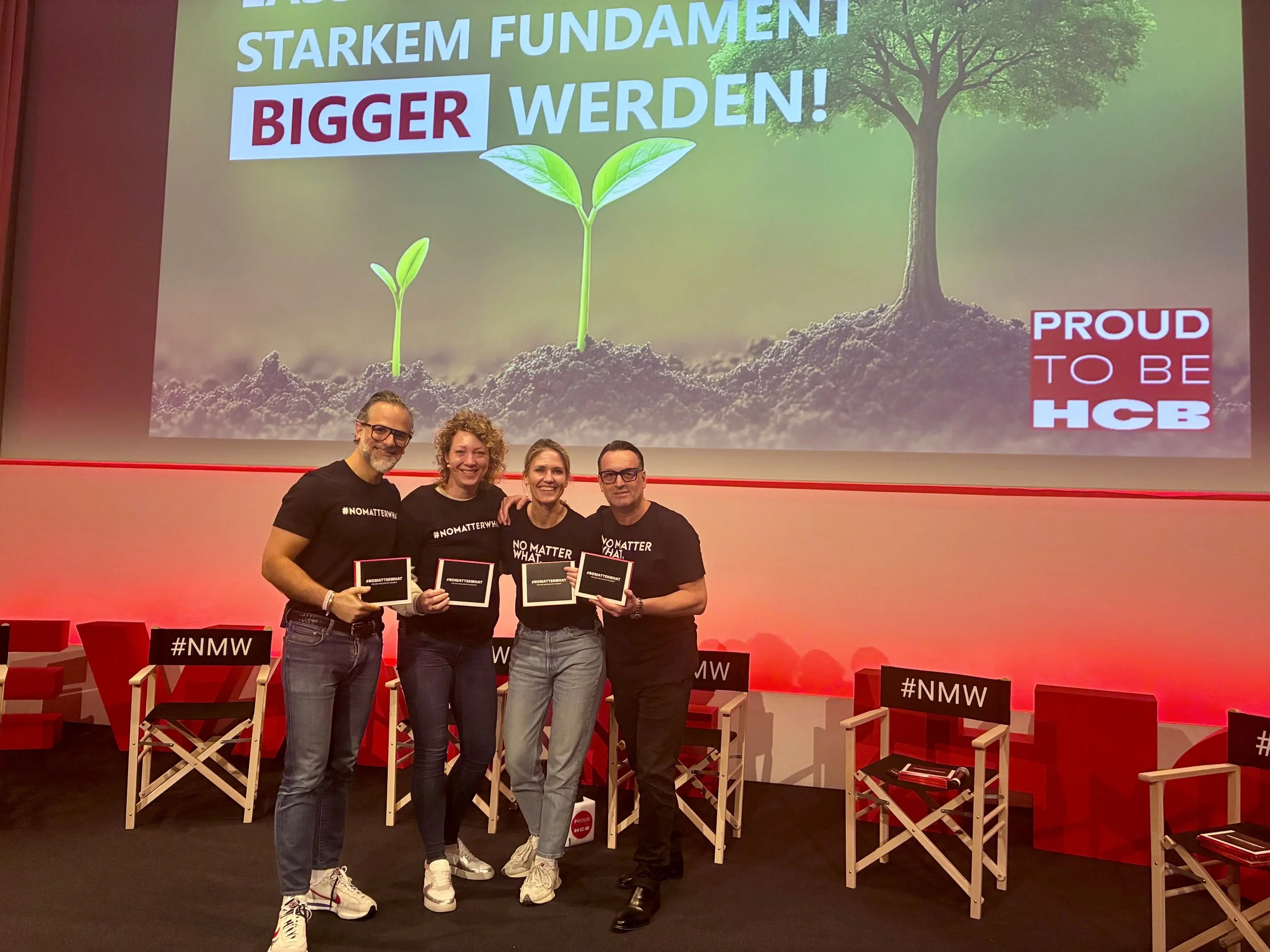
Over the course of three keynote engagements, Sterling worked with Henkel leaders across different parts of the organization — first in Budapest, then with Henkel Germany, and finally with Henkel Consumer Brands across the Middle East & Africa.
Book signings
Post-keynote momentum toolkit
No Matter What merch for key teams
The audience:
Senior executives, regional leaders, sales teams, key account managers, and cross-functional teams across Henkel's global organization.
CLIENT CHALLENGES:
Strategy was changing, but the culture had to catch up
Henkel was navigating mergers, evolving growth strategies, and major organizational transformation. The strategy was clear on paper, but leaders still had to bring people with them through the uncertainty.
The challenge was not simply communicating what was changing. It was helping people change how they responded to it.
As Wolfgang König, Executive Vice President of Henkel Consumer Brands, put it, Sterling's keynote stood out because he “started by understanding us” — exploring the organization's challenges, culture, and goals before building a narrative around what the team actually needed.
Different regions faced different kinds of pressure
The challenges weren't the same across Henkel.
Germany was moving from post-merger stabilization into an ambitious growth phase. In the Middle East & Africa, leaders were dealing with geopolitical instability, rising costs, material shortages, and security concerns.
The common challenge was learning how to move forward when the conditions couldn't simply be changed.
As Ahmed Nasser described it, Sterling's message around “hunting the discomfort” was particularly relevant to the region because they were already living with uncertainty every day.
They needed behavior change, not another strategy
Henkel didn't need more information about what to do. Leaders needed a practical way to turn strategy into behavior — especially when pressure made avoidance, excuses, or waiting for certainty the easier response.
The opportunity was to create a framework that could work at every level of the organization and in different business environments.
As Paul Vetter put it: “If you do not have this No Matter What mindset, the best strategy and the best structure will fail.”
THE RESULTS
A shared language turned mindset into behavior
The No Matter What framework gave teams a common language for navigating discomfort, uncertainty, and change.
Conversations began moving from “yes, but…” toward “this is the situation, and this is how we'll solve it.”
The shift was visible in everyday leadership and decision-making — less excuse-oriented, more solution-oriented.
Paul described it as “a totally different language within your team” that could create movement beyond the individual.
Ownership moved from an idea to measurable behavior
The framework moved into practical business situations rather than staying on the keynote stage.
In Germany, key account managers used No Matter What commitments to take personal ownership of ambitious goals rather than simply receiving top-down targets.
In the Middle East & Africa, Ahmed estimated leadership ownership and accountability increased from approximately 5–6/10 before the keynote to 7/10 afterward.
That ownership was tested in real business conditions. In Algeria, teams used the framework to find a path through difficult planning and pricing challenges — including successfully implementing price increases during wartime pressure through collaboration across R&D, Purchasing, and Sales.
As Ahmed said: “The team members started to find the solution within themselves.”
One keynote became three engagements across the organization
The strongest proof wasn't another feedback form. It was what happened next.
Sterling's first engagement with Henkel was in Budapest. After seeing the message, Henkel Germany brought him in to work with its own organization. Then Ahmed brought the framework to the Middle East & Africa after seeing how Germany had adapted it.
That created three keynote engagements across different regions and business environments — each tailored to the specific audience and moment.
The message remained consistent while the application changed.
Ahmed captured the reason Henkel continued bringing Sterling into new regions: “I would definitely advise any other region to do it. I would also add to tailor it to the moment, to the challenges, to the audience.”
What started as a keynote became a framework Henkel leaders could carry across the organization.
You alone can move, but you cannot move a full team.
Sterling's keynote helped lay the foundation for that team movement.
Our Methodology
Breakthrough cultures drive breakthrough performance. We’ve built a 12 week, 5-step process to identify and solve for root problems to deliver maximum impact before, during and after events.



Growth No Matter what starts here.
Inquire about bringing me into your next event.